![]() |
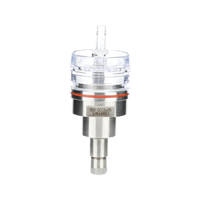
Triplex Cyclone (SCC 1.062) -- PM1, PM2.5 & Respirable |
|
|
Download the latest version of the instruction manual. ApplicationsWith growing interest and concern over diesel "soot", the need has arisen for a "PM1" personal sampler to investigate this fraction in the workplace1,2. Additionally, with PM2.5 firmly established the measurement of choice for Ambient and Indoor Air Quality, there is interest in what fraction of PM2.5 may be PM12. HistoricalA series of papers has been carefully building models of several types of ambient and personal cyclones for the diverse measurements of the size cut (D50) performance, of use to a variety of investigators4,5. These D50's include PM2.5, Respirable, PM10 and Thoracic. These papers have also firmly established the concept of referring to the "slope" of a Size Selective Inlets (SSI) penetration curve by an approximation of the Geometric Standard Deviation (GSD). Introduced by Peters et al6, this measurement is now referred to as "sharpness" to avoid confusion with the GSD. It is calculated from the penetration curve as: S = (D16/D84)0.5 Where: S = Sharpness Lower sharpness number (1.15-1.25) are associated with SSI's for ambient investigations. Larger numbers, up to 1.4 are related to SSI's for occupational monitoring. Overlaps can be observed where IAQ devices are employed. Flow Rates/DesignThe Triplex Cyclone was designed to solve the problem of achieving a high flow rate personal sampler for PM1 applications combined with a well defined, sharp penetration curve at a flow rate of 3.5 lpm. Further investigation revealed a good fit to the EPA curve for PM2.56 at 1.5 Lpm. A D50 cut of 4µm was also found at 1.05 Lpm which was sharper then the respirable curve and should be more properly referred to as PM4. The technical report on the development of this SSI may be viewed and downloaded by clicking at the top of this page. A graph of the penetration curves, at the three significant flow rates may be seen to the left, as well as a D50 vs. flow rate graph.
In order to enhance the omni-directionality of this cyclone, it has been given a "shrouded" inlet, first introduced by Higgins and Dwell7 for their original respirable cyclone. While this type of entry lacks the convenience, when performing an air flow calibration, of a single point inlet, it should be more forgiving of drafty environments. A press-on calibration chamber has been created for convenient use. ApplicationsAlthough primarily intended as a PM1 personal sampler, it will also perform as a PM2.5 sampler where anticipated concentrations are high and only normal flow rate personal samplers are available. As the SSI for a particulate concentration photometer, the Triplex cyclone is ideal, giving a readily selectable "cut" with only an adjustment of pump flow rate. In this application a calibrated light scattering photometer becomes the ideal survey instrument for ambient, occupation and IAQ rapid investigations. As an aid to selecting the appropriate pump for personal or area monitoring applications, the total pressure drop of various 37mm filter media have been measured when installed on the cyclone. These figures include the pressure drop of the cyclone, media, backing pad (membranes only) cassette and Luer connector used to connect the cassette.
References
Copyright © 2006 by BGI / Modified:
Thursday, January 3, 2008
|
||||||||||||||||||||||||||||||||||||||||||||||||||||||||||||||||||||||||||||||||||||||